Tag: reading

  • The Intimacy of Shared Literature: Connecting Through Books

    The Intimacy of Shared Literature: Connecting Through Books

    As I reached the final lines of the epilogue in Crime and Punishment, I found myself more tangled in thought than ever before. I had been sitting with this book for two months, reading it slowly—methodically, I told myself—to let it all sink in. After all, Dostoevsky is not to be rushed.

    But the truth is, I wasn’t savoring the prose because of its weighty philosophical depth (although it certainly has that in spades). I was savoring it because it had once belonged to someone else. Someone I dare call my lover. He had pressed it into my hands and said he wanted me to read it. And I, in turn, read it as if each word were a red string that once bound itself to his thoughts. The pages were heavy with a quiet sort of intimacy. His fingertips had grazed every chapter, his eyes scanned the same moral quandaries I now confronted. And there was something magnetic—almost haunting. Do stories remember the hands that held them? I like to think so.

    This wasn’t the first time. He once gave me his favourite novel, Anna Karenina. And I found myself holding onto every word—not for clarity, but closeness. He had once mentioned that I reminded him of Kitty. Her quiet heart and Levin’s restless mind—we became the story, or at least a reflection of it. They say love lives in the details. I say it lives in the books we pass between each other.

    It makes me wonder: are we all connected through the literature we’ve read? Could it be that books, passed from hand to hand, from era to era, act as spiritual conduits between us?

    These stories, published in the late 1800s—a golden age for writers and romantics alike—remain prevalent in our lives. Millions before me have sat by candlelight or coffee cup with Anna Karenina or Crime and Punishment in hand. They’ve felt the same pang in their hearts, the same breathlessness on certain pages. And now, so have I. And so has he.

    There’s a unique tenderness in discovering someone has read the same book as you. A kind of gentle collision of hearts. When I tell my grandmother what I’m reading and she says, “Oh, I read that when I was your age,” I feel momentarily tethered to a version of her I never knew. It’s the simplest kind of looking glass into the past.

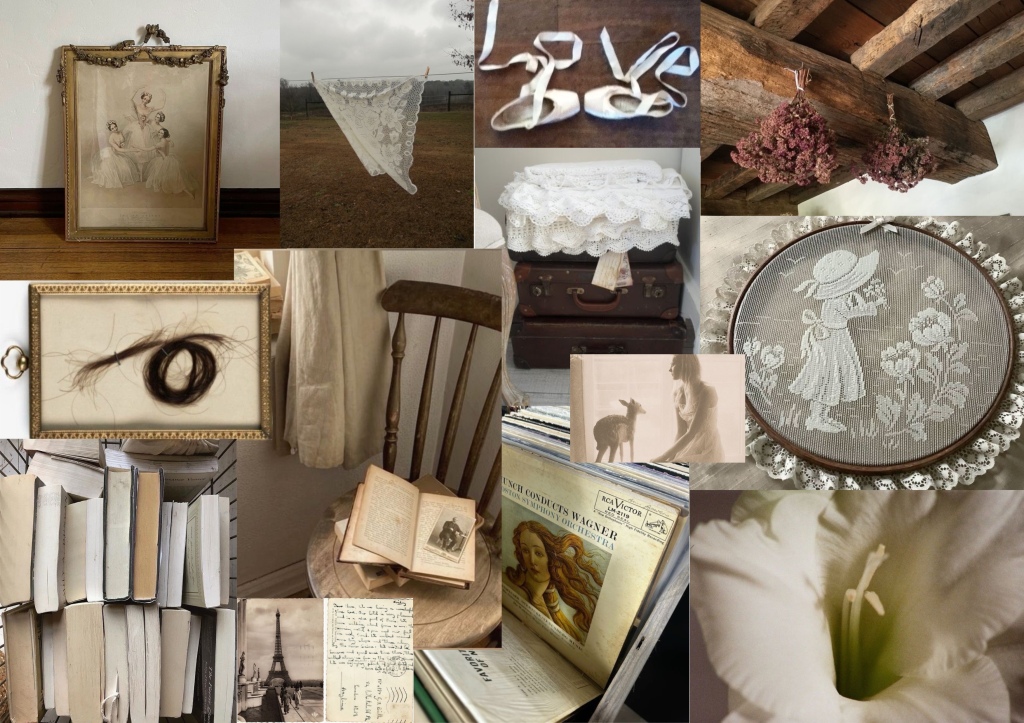
    Just the other day, I was fluttering around a used bookstore—when I pulled out a worn copy of Little Women (naturally). The cover was torn, the spine cracked, the pages yellowed and stained by the sun. It flopped open in the middle, its body softened by time. I always know when a book has lived in the bottom of a woman’s tote bag—that’s where all my books seem to end up, too.

    Inside, between the dialogue of Jo and Meg, was a tiny black and white photograph of a baby. A few chapters later: a red ribbon. A little further in, a delicate sketch of a wildflower. These were more than just forgotten keepsakes. They were relics. Evidence of past lives lived alongside the March sisters. Whoever she was, she had tucked her heart into those pages.

    It’s the same feeling I get when I stumble across an antique brooch in a flea market stall, or a dainty French perfume bottle from the 1940s nestled behind a row of mismatched china cups. I never just see an object—I see a life. I imagine the woman who once pinned that brooch to her collar before heading to a café in the rain, or the girl who dabbed that perfume on her wrists before a first kiss. These things, seemingly forgotten and left behind, radiate with memory. They feel sacred in their ordinariness. Do they really hold the energy of those who loved them before us? Or is it simply our desire to believe in permanence, in continuity? Either way, there’s something profoundly romantic in the act of caring for what once belonged to someone else. In loving something because it was loved before.

    And then there are paintings. That quiet, unspoken thrill when someone speaks of an obscure Pre-Raphaelite portrait or a dusty Rococo landscape and is met with, “I know that one.” It’s like a soft gasp from the universe, a small nod that says yes, you’ve been seen. There’s a rare kind of togetherness in that recognition— Art becomes a bridge. It’s no longer about taste or knowledge—it’s about feeling something that another person also felt. Art, too, binds us in quiet, revered ways. It’s like saying, I’ve seen the same ghost as you. Or I’ve mourned the same thing. I’ve marveled at the same light.  

    So maybe this is what connection really is. Not grand declarations or cinematic moments, but the subtle synchrony of shared references. The silent, tender knowledge that someone else has stood in the same emotional weather as you. A line in a book. A yellowed page. A photograph between chapters. A wildflower sketched in graphite. 

    Maybe love—real love—is just the act of handing someone your favorite story, and waiting to see which page they dog-ear first. Not because you’re testing them, but because you’re dying to see what moved them. To learn the language of their feelings. To find out where their heart softened—if it softened in the same place yours did. And if it didn’t, well, maybe that’s even more beautiful. Maybe love is simply the shared willingness to be moved at all.
  • The Lonely Hearts of Literature: Why So Many of the Greatest Female Romance Writers Never Married.

    The Lonely Hearts of Literature: Why So Many of the Greatest Female Romance Writers Never Married.

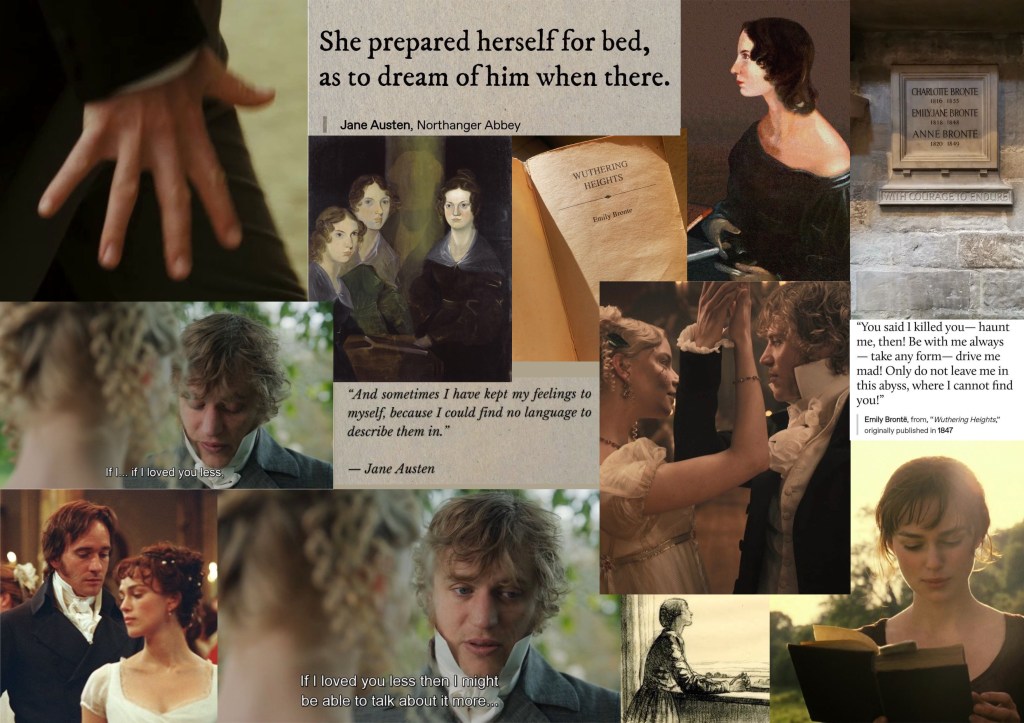
    There is a peculiar irony that lingers in the pages of history: some of the greatest love stories ever written were crafted by women who never lived them. Jane Austen, who gave us the sharp-witted and swoon-worthy Mr. Darcy, never married. The Brontë sisters, whose novels are infused with lust and longing, lived quiet, uneventful lives, largely untouched by romance. Emily Dickinson, whose poetry reads like the breath of a love-stricken heart, spent much of her life in solitude, sending letters to an unnamed beloved who may never have truly existed.

    And yet, these women captured love better than those who lived and lost it. Their words are corroded into our collective consciousness, their stories devoured by generations who turn to fiction in search of the love they cannot find in reality. Why is it that the women who understood love so deeply, who could write it into existence so convincingly, never found it for themselves?

    To be a woman writer in the 18th and 19th centuries was to make a choice. The quiet comfort of marriage or the wild freedom of the mind. Few could have both. Marriage, for most women of that time, was a legal and financial transaction, one that rarely allowed room for creative ambition. 

    Jane Austen, whose novels overflow with canniness and romance, knew this reality all too well. She had her chances, there was Tom Lefroy, a youthful flirtation that was cut short by his family, and Harris Bigg-Wither, whom she briefly accepted before recoiling at the thought of a life bound in uninspired matrimony. In the end, Jane chose her pen over a ring, writing to her niece that “anything is to be preferred or endured rather than marrying without affection.”

    The Brontës, too, lived in a world where marriage was often a compromise rather than a grand love affair. They were raised in near isolation on the Yorkshire moors, their imaginations fed by the rolling hills and the books they devoured. Emily Brontë, the most reclusive of the three, never married, never seemed to have a lover, and yet she wrote Wuthering Heights—a novel so feverish, so consumed by passion, that it seems impossible that it came from the mind of a woman who had never known love herself. Perhaps, for Emily, love existed more beautifully in her imagination than in reality. 

    It is natural to assume that a writer must experience these moments to write it well, but history proves otherwise. In fact, distance may have given these women an even greater ability to understand love. Free from the distractions of real-world relationships which are often messy, mundane, and often disappointing. They were able to construct love in its purest, most idealized form. 

    This may be why their love stories endure. Their understanding of romance was not clouded by the small, inevitable disenchantments of everyday life. They wrote of soulmates, of passion that defied reason, of love that burned so intensely it could only end in tragedy or eternity.

    Emily Dickinson, for example, wrote poetry that oozed with longing. Her words were intimate, secretive, as though written in the dead of night for a lover she could never touch. “Wild nights—wild nights! / Were I with thee,” she wrote, though history gives us little proof that she was ever truly with anyone at all. Perhaps she didn’t need to be. The craving itself was enough.

    Another aspect, a tale the modern woman now knows too well, is that maybe the reason why so many of these women never found love, is that they were simply too extraordinary for the time in which they lived. The men around them could not match their minds, could not keep up with their wit, could not understand the depths of their ambition. 

    Imagine being a woman in Austen’s time, capable of crafting dialogue so sharp it could draw blood, so perceptive it could dismantle an entire social structure in a single sentence. What man could keep up? Imagine being Emily Brontë, so enraptured by the profundity of her imagination that no earthly love could compare. Who could be her Heathcliff?

    It is tempting to mourn for these women, to wish they had known the great, sweeping loves they so beautifully captured on the page. But perhaps, in some way, they did. Perhaps their love was not meant for one man, for one fleeting romance, but for something far greater. Their love was for the world, for the women who would read their words centuries later and find themselves within them.

    Love, after all, is not just something to be lived—it is something to be imagined, to be felt, to be created. And in that, these women were never without it.

    Would love have made their work greater, or would it have dulled the longing that made it so extraordinary?  

  • Embracing Literary Luxe: The Convergence of Style and Knowledge

    Embracing Literary Luxe: The Convergence of Style and Knowledge

    Summoning a sense of romantic nostalgia, Libraries will always encapsulate a tranquil reverence for knowledge and storytelling that withstands lifetimes. I picture myself as a child wide-eyed and soaking up the rows of worn hardcover books, the smell of aged pages, the hushed whispers and the soft echo of footsteps emanating from those browsing. In contrast, the particular energy flowing from the books, which countless souls have found solace and escape from the adventures between the bindings. 

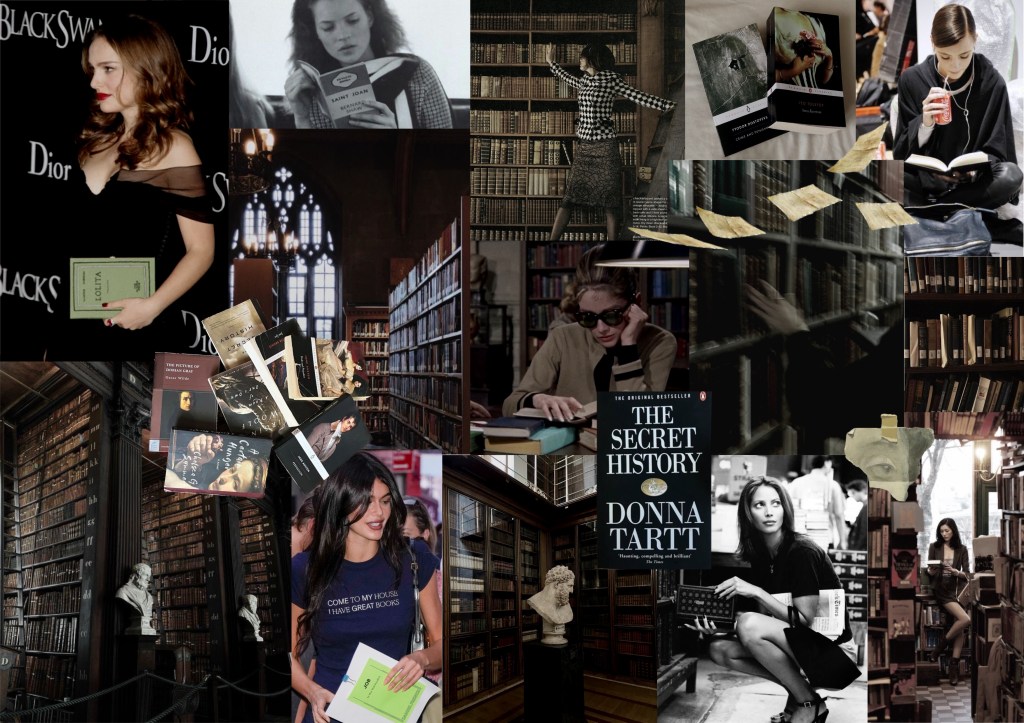
    For what was believed to be a timeless space, the library lost its footing to the rise of technology; however, due to a blend  of sentimentality and vintage charm, stepping into a library has never been more fashionable. For many, dressing up and going to the library is a way to channel the intellectual elegance of another era, like stepping into a scene from The Secret History.

    Think tailored tweed jackets with oversized wool sweaters underneath, a mini skirt and tights, a tortoiseshell headband and a leather-bound journal set against a backdrop of bookshelves and wooden tables, a celebration of classic academic style illuminated by natural light streaming through old windows. I consider this to be the “literary lux” aesthetic unique in its commitment to creating a visual narrative where intellect and opulence coexist. 

    But would it be unproductive to cement this practice into a two-word aesthetic? A hashtag online? This trend speaks to a louder cultural shift towards slowing down, disconnecting, putting down the blue light, and picking up the pages. After all, the idea of escaping modernity is what conjures up a trending aesthetic anyway. But this is special; it comes from the deliberate choice to opt for a place of knowledge over distraction to pick up a book instead of scrolling on social media. It’s about reading, learning, and the pursuit of knowledge being aspirational again. 

    That is not to say we cannot romanticise; there is already a plethora of perfectly curated snapshots of people reading in beautifully designed spaces—plush armchairs, stacks of novels, showing off a book collection; it’s about capturing the atmosphere of being immersed in literature and learning, making the library a trendy place to be. The content creation does not stop there. Here, high fashion meets literary culture with a curated aesthetic that’s as much about personal expression as it is about the love of books.

    Books are the ultimate accessory that adds a layer of personalisation to the Literary Luxe look. Just as a particular designer bag says something about the wearer’s taste, so does a carefully chosen novel. A tattered copy of Wuthering Heights suggests a brooding romanticism, while a sleek, modern edition of The Metamorphosis hints at a more intellectual, dystopian vibe. In this way, books allow individuals to communicate their personality and style preferences without saying a word. In the realm of Literary Luxe, the book you carry is as important as the bag on your arm or the shoes on your feet. 


    One of the most notable examples of this trend is Olympia Le-Tan’s iconic book clutch bags, which have become a favourite of style icons like Natalie Portman and Emma Watson. These embroidered clutches are designed to resemble the covers of classic novels, such as when Natalie Portman carried the Lolita clutch on the red carpet at the 2010 premiere of Black Swan. This aesthetic also manifests through influencers on Instagram who often style outfits to match the books they read. These posts feature beautifully composed shots of clothes paired with hardcover books, frequently set in picturesque locations such as vintage libraries or luxurious cafes. The books become an extension of their style, creating an intersection between fashion and reading culture.