I visited an obscene number of museums this month, and somewhere between the Louvre and the Rijks, I began mentally composing a rather unpleasant little essay.
To preface, I am an art museum snob. I have studied art for five years, and frankly, I can be insufferable about it. So there I was, scavenging the galleries for inspiration, reacquainting myself with paintings I had studied, and finally inspecting sculptures I had previously known only through the rather disappointing medium of a computer screen, when I encountered something considerably less inspiring: People trying to create slide three of their 9:13 Instagram carousel.
Now, before I sound entirely intolerable, I should clarify that I am very much in favour of the general public. In theory. I do believe museums should be accessible, that art belongs to everyone, and that an appreciation for painting should not require a degree or an encyclopedic knowledge of dead Italians. But I also believe that standing directly in front of a painting to conduct a personal photoshoot while twenty people attempt to look around you is grounds for a certain amount of public ridicule.
I witnessed camera flashes, elbows, elaborate posing, and people who appeared to have mistaken the Louvre for a particularly expensive photo studio. One woman spent several minutes arranging herself in front of the The Coronation of Napoleon painting, took her photograph, inspected the result, and departed without so much as glancing at the work behind her. Napoleon, I imagine, was devastated.
What bothered me wasn’t the photography itself. I take photographs in museums. Most people do. It was the extraordinary indifference with which some visitors approached the very things they had paid to see. There was something almost comical about watching people hurry past rooms filled with centuries of artistic achievement, only to stop dead in their tracks when they encountered something sufficiently famous.
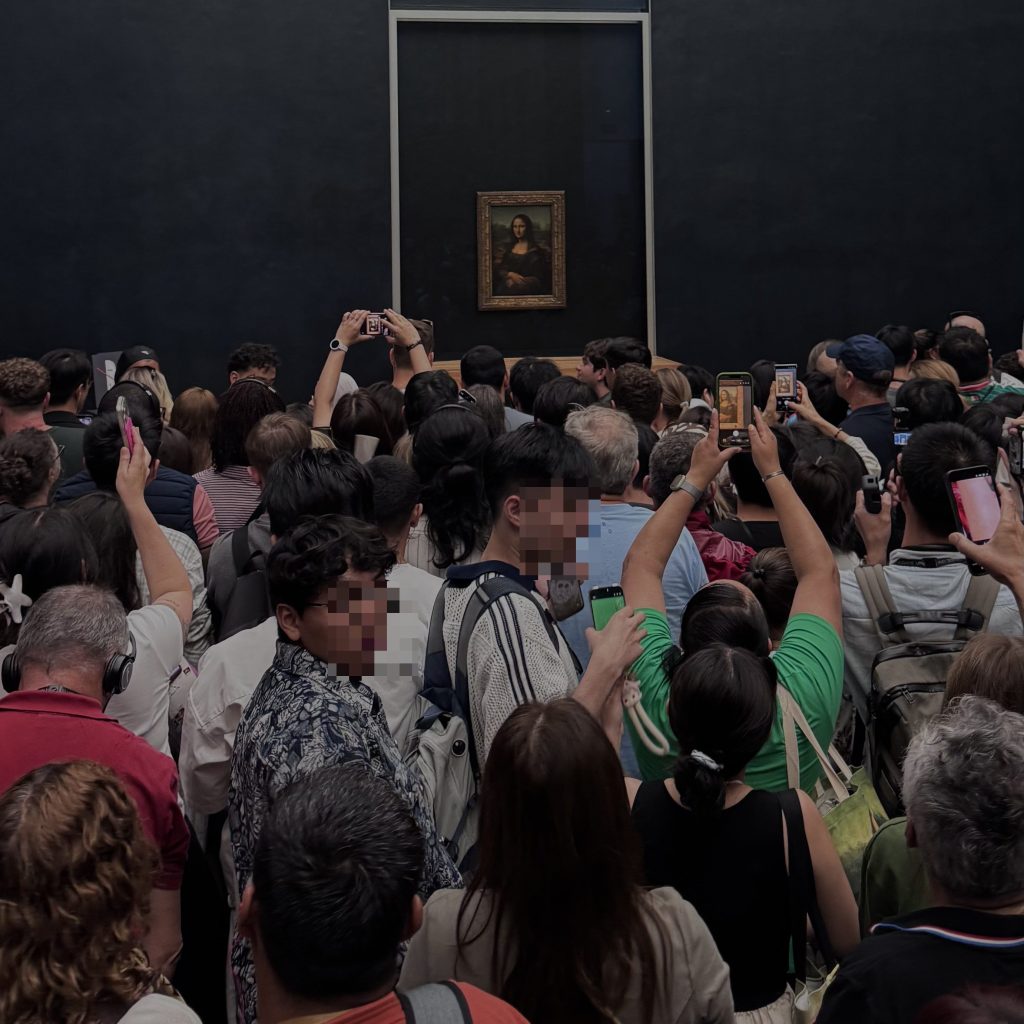
The Mona Lisa is perhaps the most obvious victim of this phenomenon. Hundreds of people assemble before her, phones raised above their heads, straining to capture an image of a painting they can barely see. Meanwhile, the surrounding galleries contain extraordinary works that receive a fraction of the attention. It is difficult not to wonder how many people would find Leonardo’s portrait particularly interesting if they had never been told it was important.
This is not to suggest that the Mona Lisa is undeserving of her reputation, nor that everyone needs to possess an informed opinion on Renaissance portraiture. But I do find it curious how readily we surrender our own judgement to the cultural consensus. We are told something is a masterpiece, and so we dutifully admire it, or at least arrange ourselves in its vicinity.
There is a strange passivity to this sort of cultural consumption. We arrive knowing what we are supposed to see, what we are supposed to admire, and, increasingly, what our admiration is supposed to look like. The museum becomes a checklist of famous objects rather than a place of discovery. We leave having seen everything we were instructed to see and very little that we actually noticed. Perhaps the problem is not that people have stopped appreciating art, but that we’ve become uncomfortable with the effort appreciation demands.
Art requires something of its audience. Not necessarily intelligence, education, or even good taste, but attention. The willingness to stand before something without immediately understanding it, to be bored occasionally, to dislike something celebrated, or to become inexplicably attached to a painting by an artist whose name you cannot pronounce.These are small acts of independent judgement, and I suspect we exercise them less often than we think.
I have spent years studying art, and I still regularly encounter paintings that leave me entirely cold. Sometimes I find a supposedly magnificent work rather dull. Sometimes an obscure little portrait tucked away in the corner of a gallery will occupy my thoughts for days. I consider both experiences equally valuable. There is no obligation to be moved by something simply because a museum has deemed it worthy of preservation. In fact, I would argue that having a genuine dislike for a painting is considerably more interesting than pretending to adore it.
So, you’ve paid your 35 euros, endured the queue, and secured your OOTD reel with Van Gogh’s Sunflowers as a background. What now? I have a little ritual when visiting museums. Rather than attempting to document everything of importance, I photograph the works that provoke some sort of reaction in me. It might be admiration, curiosity, discomfort, or something as unsophisticated as thinking a particular shade of blue is exceptionally pretty. I make no apologies for the latter. Aesthetics are a perfectly legitimate reason to like something.
Later, I revisit those photographs, look into the artists, read about the subjects, and occasionally discover that the painting I liked for entirely superficial reasons has a rather fascinating history. Other images become references for writing, design, or little collections of things I find pleasing. It is a modest exercise, but one that has made me a more curious observer.
I am not proposing that every museum visitor become an amateur art historian, nor that an afternoon at the Louvre should resemble a compulsory university seminar. Quite the opposite. I would like people to feel more entitled to their own reactions, however uninformed, peculiar, or contrary they might be.There is something democratic about standing in front of a painting and deciding, entirely for yourself, whether it is any good.
We live in an age of extraordinary cultural accessibility. We are looking at masterpieces that were once the private possessions of monarchs and aristocrats, and are now available to anyone willing to buy a ticket. The opportunity to stand before an object that has outlived entire political regimes, survived revolutions, and witnessed centuries of human history is, when you really consider it, rather astonishing.
There is, of course, one rather inconvenient detail I have neglected to mention. I run an art account. I too make entire posts dedicated to looking at paintings and then making other people look at them too. I also returned from trips and promptly subjected my followers to a carousel and what must have been several hundred Instagram stories documenting my museum visits. A rather damning amount of evidence against a girl who has just spent the better part of an essay complaining about other people’s cameras.
But I suppose self-awareness is the first step towards recovery, and unfortunately, I have no intention of recovering. My camera roll is full, my opinions remain unsolicited, and I have already begun planning my next museum visit.