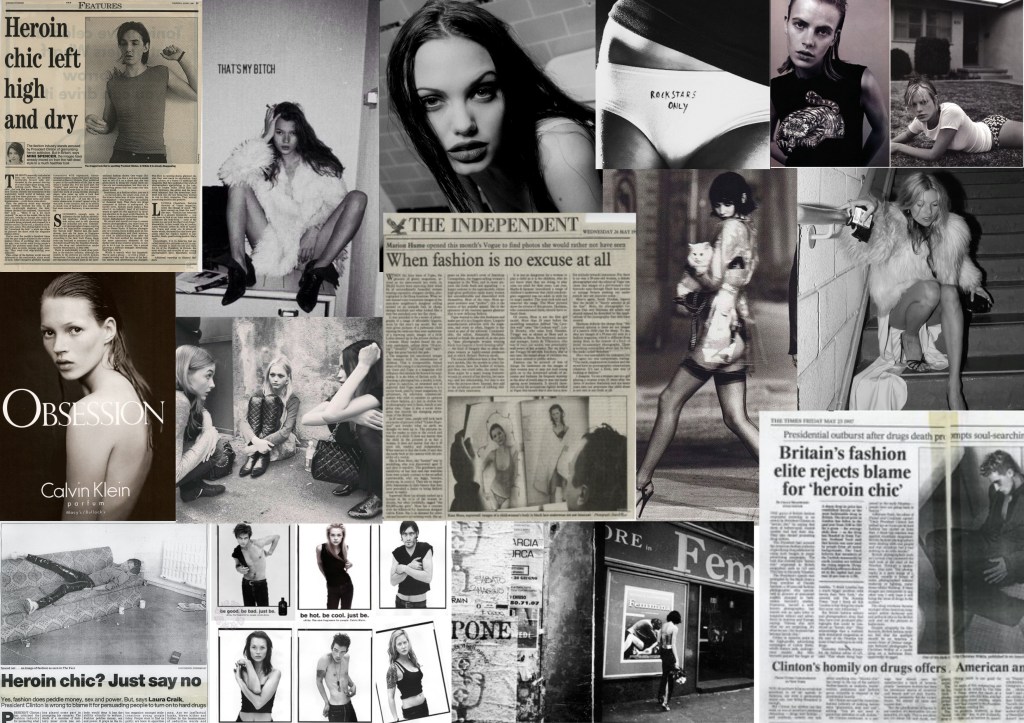
Ah, Heroin Chic. Even the name drips with controversy, conjuring images of hollowed-out cheekbones, smudged eyeliner, and a willowy frailty that could snap in a stiff breeze. If the ’80s were cocaine-dusted, champagne-fueled opulence, the ’90s dragged the party into the bathroom stall and turned on the flickering fluorescent light. This wasn’t just fashion; it was a full-blown aesthetic manifesto: decay, addiction, and rebellion served up as sexy, gritty art.
Kate Moss—our poster child for the movement—was the face of this revolution. Waifish and wide-eyed, she became synonymous with the look. Who could forget the first time you stumbled across the infamous quote on Tumblr, “Nothing tastes as good as skinny feels,” paired with Kate’s haunting gaze? It’s an image seared into the collective memory of anyone who’s ever searched “edgy thinspo” at 2 a.m. Designers like Calvin Klein lapped it up, splashing this aesthetic across runways and ad campaigns. It was androgyny, fragility, and just rolled out of a bar fight with my rockstar boyfriend chic—a sharp pivot from the ’80s supermodel era, where big hair, big smiles, and big egos reigned supreme.
Behind the scenes, photographers like Corinne Day and David Sims doubled down on the rawness. Their work didn’t just flirt with the spirit of this aesthetic—it French-kissed it in a back alley. Unapologetically romanticizing the messy, tragic seduction of addiction and alienation. The aesthetic bled into pop culture, turning up everywhere from Vogue to MTV. It was grunge for your closet, nihilism in a mascara ad.
But not everyone was clapping. Critics—and there were plenty—called the whole thing out for what it was: a thinly veiled glorification of addiction and an unhealthy body image. The timing couldn’t have been worse. While Heroin Chic’s hollow-eyed muses smoldered on magazine covers, the heroin epidemic was wrecking communities across the world. Addiction, suffering, and death weren’t chic—they were devastating.
And let’s not forget the body image disaster. This era did a number on how we define beauty. Models looked less “fashionably thin” and more “haven’t eaten since the Clinton administration.” For anyone struggling with body image, this was gasoline on an already raging fire. Eating disorders spiked, and young people everywhere were left chasing an unattainable ideal.
By the late ’90s, the pendulum started to swing back. Fashion had its oops, maybe we went too far moment. Healthier bodies began to appear on runways, and Heroin Chic was quietly shuffled into the “bad idea” file of fashion history. But the damage was done. The ripple effects—on both the modeling industry and society at large—are still felt today.
And speaking of the modeling industry, sure, we’ve made progress. Runways now host a kaleidoscope of body types, and “body positivity” is more than just a trending keyword. But the shadow of Heroin Chic still looms, a cautionary tale wrapped in chiffon and eyeliner.
So let’s call Heroin Chic what it was: a moment of rebellion that danced with danger but left us with scars. It challenged beauty standards, but at a cost we’re still paying. The toll? Hormonal wreckage, mental health crises, and a generation of young people who think happiness comes in size 0. While we might be tempted to romanticize it in the warmth of nostalgia, let’s not forget the cold, hard truth: some trends should stay buried in the archives.
 Atelier Lauren Jane