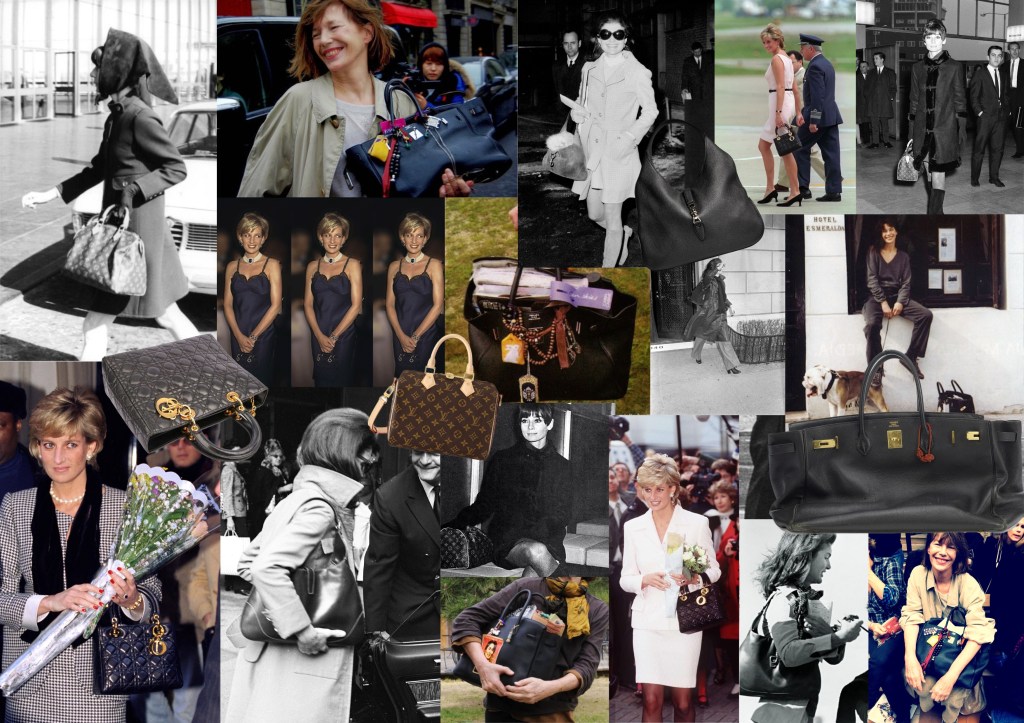
Audrey, Diana, Jackie, and Jane—what do they have in common besides fabulous wardrobes that are forever cemented in the universe of fashion? Well, when you’re the walking definition of chic, it’s basically a requirement to inspire a handbag. That’s right—if you haven’t been the muse for some designer’s “It” bag, are you even a fashion icon? From Audrey and Jane’s jet-setting escapades to Diana and Jackie’s unfortunate oversized marital accessories (now more commonly known as King Charles and JFK), these women didn’t just set trends—they were, quite literally, the blueprint of fashion. And nothing says “immortal style” like a handbag that bears your name.
Let’s dive into the early 1960s when women’s accessories were either delicate and dainty for evening events or large and cumbersome for travel. Also, when people wore much more than Lululemon leggings and a fjall raven Kanken backpack to the airport (can you imagine?), when air travel was glamorous, Audrey Hepburn was flitting from set to set, filming iconic movies like Breakfast at Tiffany’s. Naturally, she needed a bag as elegant and functional as she was. Enter Louis Vuitton.
At the time, the Louis Vuitton Speedy was already a staple for stylish travellers, but it came in sizes that were, well, speedy in name but not exactly petite in design. The original sizes (30, 35, and 40) were ideal for jet-setting, but Audrey had other ideas. She requested a smaller version—a size that would fit into her everyday life. Vuitton obliged, and thus, the Speedy 25 was born. This bag quickly became her signature accessory, often nestled on her arm as she sauntered through airports and film sets.
Its balance of form and function made the Speedy 25 revolutionary. Before Audrey’s influence, handbags were often too structured or over-embellished for casual use. The Speedy, however, was crafted from Louis Vuitton’s signature coated canvas, which made it both durable and lightweight—perfect for the demands of an international star but practical enough for anyone. The bag’s rounded shape and roomy interior also meant you could fit your essentials (and let’s face it, a little more than just a lipstick and compact). The smaller size gave it a more feminine and refined edge, aligning perfectly with Hepburn’s aesthetic. I, too, own the speedy 25-brown monogram for this exact reason. When I carry this, I hope I exude her elegance and hopefulness for kindness in the world.
Similarly, in 1983, Jane Birkin, famous for her bohemian charm, French-girl style, and being Hermes’ muse, As legend has it, she found herself on a flight from Paris to London. Seated next to Jean-Louis Dumas, the head of Hermès. Mid-flight, Birkin spilt the contents of her famously overstuffed straw tote all over the aisle. As she scrambled to collect her things, she complained to Dumas about how difficult the search was to find a leather weekend bag that was both practical and stylish. As one for a challenge, Dumas sketched the design of what would eventually become the Birkin bag on an air sickness paper bag.
This impromptu brainstorming session resulted in a handbag that was large, supple, and effortlessly chic—just like Jane herself. It was designed with a spacious interior (to avoid another mid-flight spill), sturdy leather, and a shape that could easily transition from airport style to Parisian café cool. Thus, the Birkin was born.
She wasn’t just the perfect ambassador for a bag; she was a walking embodiment of it, and her personal style reflected the changing attitudes toward fashion in the late 60s and 70s. Birkin’s appeal was all about breaking the rules. She wore mini-dresses and flats to formal events, embraced androgynous fashion long before it was trendy, and made baskets look like haute couture. So when Dumas created a bag for her, it wasn’t just a nice accessory—it was designed with her lifestyle in mind. The Birkin bag had to be functional and roomy yet still exude that undeniable luxury that comes with the Hermès name. And that’s precisely what the bag became.
Jane was famously nonchalant about the bag that bore her name. She used it to carry everything from baby bottles to scripts and even slapped stickers on hers to make it feel more personal. It is a reminder that the most luxurious things in life often come from the most unexpected moments—like a spill on a plane and a creative spark that followed.
Another pairing I adore is between Dior and Princess Diana. Diana’s influence on fashion was nothing short of revolutionary. And among the many stylish moments she gave us, none is more quintessential than her association with the Lady Dior bag. Given by the French First Lady, Bernadette Chirac, when Diana received the beautifully quilted, structured handbag, something magical happened. She loved it. So much so that she began carrying it everywhere, from official visits to her philanthropic engagements. Soon, the bag became her go-to accessory, photographed alongside her wherever she went.
Just like Diana herself, It could easily transition from day to night, from a charity gala to a stroll through a Parisian garden. This adaptability mirrored Diana’s evolution from a shy, young princess to a confident, self-assured global humanitarian. Her love for Lady Dior reflected her growing independence and how she wielded fashion as a personal power statement.
She inspired a movement of women who saw her as a beacon of strength, compassion, and independence. And that’s what makes the Lady Dior so much more than a handbag—it’s a reminder of Diana’s powerful influence and her unwavering ability to redefine what it means to be stylish and robust.
Another favourite story of mine is a nod to one of fashion’s most iconic muses: Jackie Kennedy Onassis. The former First Lady of the US was so smitten with this particular handbag by Gucci. Initially introduced in the 1950s, it was known as the “Constance,” a sleek, hobo-style handbag crafted from soft leather and featuring the brand’s signature piston-shaped closure. The Jackie bag was also ahead of its time in terms of functionality. Jackie Kennedy was known for her practical approach to fashion—everything she wore had a purpose, and the Jackie bag was no exception. It was roomy enough to carry all her essentials. The design was minimal yet luxurious, which probably caught Jackie Kennedy’s eye in the first place.
Whether she was stepping off a yacht in Capri, strolling through New York, or dodging paparazzi in Rome, the bag was always by her side. It became clear that this wasn’t just any handbag—it was Jackie’s handbag. Gucci made a strategic decision by recognising the marketing gem they had in the form of Jackie’s adoration for their design. They renamed the bag the “Jackie” in honour of the woman who had made it an international sensation.
The story of the Gucci Jackie isn’t just about a bag—She didn’t follow trends; she set them. She knew what worked for her, and the world followed suit. The Gucci Jackie reflects that same spirit—classic, versatile, and always relevant.
 Atelier Lauren Jane