As I reached the final lines of the epilogue in Crime and Punishment, I found myself more tangled in thought than ever before. I had been sitting with this book for two months, reading it slowly—methodically, I told myself—to let it all sink in. After all, Dostoevsky is not to be rushed.
But the truth is, I wasn’t savoring the prose because of its weighty philosophical depth (although it certainly has that in spades). I was savoring it because it had once belonged to someone else. Someone I dare call my lover. He had pressed it into my hands and said he wanted me to read it. And I, in turn, read it as if each word were a red string that once bound itself to his thoughts. The pages were heavy with a quiet sort of intimacy. His fingertips had grazed every chapter, his eyes scanned the same moral quandaries I now confronted. And there was something magnetic—almost haunting. Do stories remember the hands that held them? I like to think so.
This wasn’t the first time. He once gave me his favourite novel, Anna Karenina. And I found myself holding onto every word—not for clarity, but closeness. He had once mentioned that I reminded him of Kitty. Her quiet heart and Levin’s restless mind—we became the story, or at least a reflection of it. They say love lives in the details. I say it lives in the books we pass between each other.
It makes me wonder: are we all connected through the literature we’ve read? Could it be that books, passed from hand to hand, from era to era, act as spiritual conduits between us?
These stories, published in the late 1800s—a golden age for writers and romantics alike—remain prevalent in our lives. Millions before me have sat by candlelight or coffee cup with Anna Karenina or Crime and Punishment in hand. They’ve felt the same pang in their hearts, the same breathlessness on certain pages. And now, so have I. And so has he.
There’s a unique tenderness in discovering someone has read the same book as you. A kind of gentle collision of hearts. When I tell my grandmother what I’m reading and she says, “Oh, I read that when I was your age,” I feel momentarily tethered to a version of her I never knew. It’s the simplest kind of looking glass into the past.
Just the other day, I was fluttering around a used bookstore—when I pulled out a worn copy of Little Women (naturally). The cover was torn, the spine cracked, the pages yellowed and stained by the sun. It flopped open in the middle, its body softened by time. I always know when a book has lived in the bottom of a woman’s tote bag—that’s where all my books seem to end up, too.
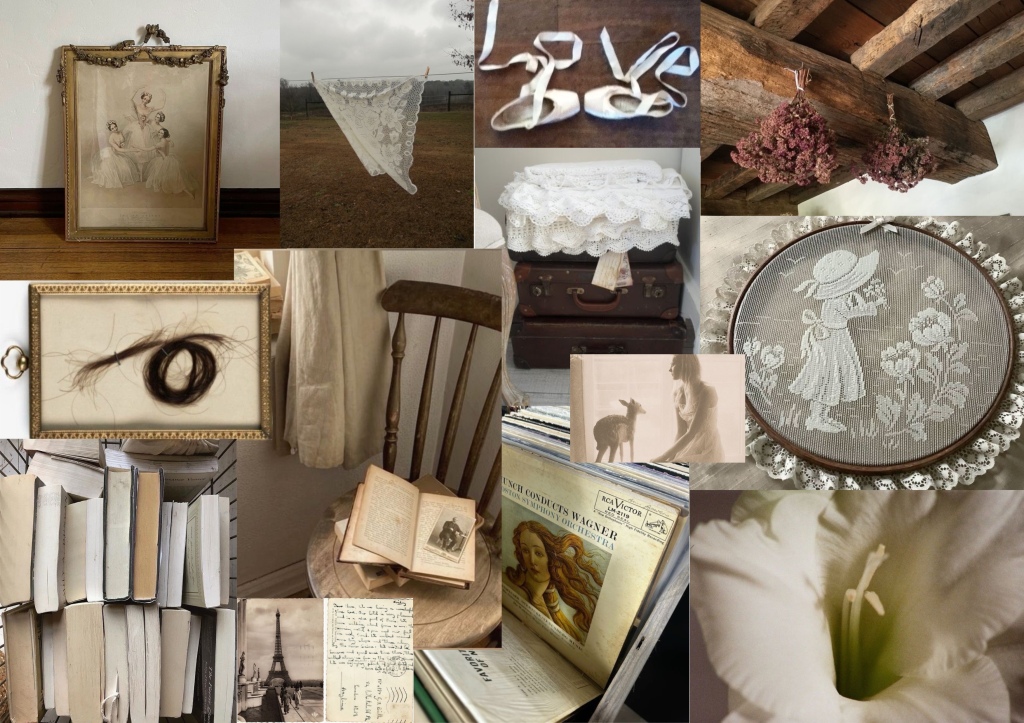
Inside, between the dialogue of Jo and Meg, was a tiny black and white photograph of a baby. A few chapters later: a red ribbon. A little further in, a delicate sketch of a wildflower. These were more than just forgotten keepsakes. They were relics. Evidence of past lives lived alongside the March sisters. Whoever she was, she had tucked her heart into those pages.
It’s the same feeling I get when I stumble across an antique brooch in a flea market stall, or a dainty French perfume bottle from the 1940s nestled behind a row of mismatched china cups. I never just see an object—I see a life. I imagine the woman who once pinned that brooch to her collar before heading to a café in the rain, or the girl who dabbed that perfume on her wrists before a first kiss. These things, seemingly forgotten and left behind, radiate with memory. They feel sacred in their ordinariness. Do they really hold the energy of those who loved them before us? Or is it simply our desire to believe in permanence, in continuity? Either way, there’s something profoundly romantic in the act of caring for what once belonged to someone else. In loving something because it was loved before.
And then there are paintings. That quiet, unspoken thrill when someone speaks of an obscure Pre-Raphaelite portrait or a dusty Rococo landscape and is met with, “I know that one.” It’s like a soft gasp from the universe, a small nod that says yes, you’ve been seen. There’s a rare kind of togetherness in that recognition— Art becomes a bridge. It’s no longer about taste or knowledge—it’s about feeling something that another person also felt. Art, too, binds us in quiet, revered ways. It’s like saying, I’ve seen the same ghost as you. Or I’ve mourned the same thing. I’ve marveled at the same light.
So maybe this is what connection really is. Not grand declarations or cinematic moments, but the subtle synchrony of shared references. The silent, tender knowledge that someone else has stood in the same emotional weather as you. A line in a book. A yellowed page. A photograph between chapters. A wildflower sketched in graphite.
Maybe love—real love—is just the act of handing someone your favorite story, and waiting to see which page they dog-ear first. Not because you’re testing them, but because you’re dying to see what moved them. To learn the language of their feelings. To find out where their heart softened—if it softened in the same place yours did. And if it didn’t, well, maybe that’s even more beautiful. Maybe love is simply the shared willingness to be moved at all.
 Atelier Lauren Jane